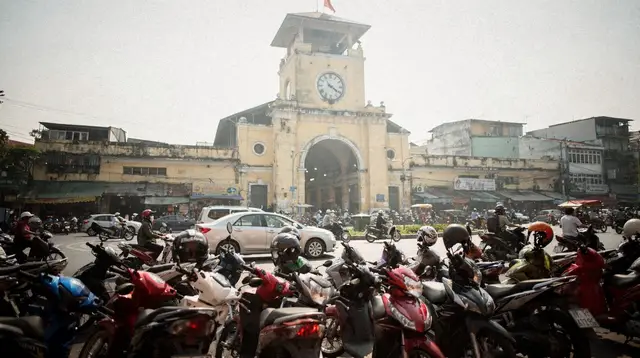
Notre Dame Cathedral and the Central Post Office
Are the Notre Dame Cathedral and the Central Post Office in Ho Chi Minh City from the same period?
Yes. Both were built under French colonial rule in the late nineteenth century, decades before Vietnam's 1976 unification. They stand across a small square from each other in District 1 and are almost always visited together.
Two Landmarks Facing Each Other Across One Square
In the heart of District 1, a small square holds two of the most photographed buildings in Ho Chi Minh City: the red-brick cathedral known as Notre-Dame Cathedral Basilica of Saigon, and, just across the open space, the Central Post Office with its arched, iron-framed hall. They are covered together on this page because they are neighbors in the most literal sense — most visitors see both within the same few minutes, without needing to plan two separate outings.
This page does not repeat the wider walk through Ben Thanh Market, the Reunification Palace, Dong Khoi or Nguyen Hue; those sights, and the rest of the central grid, are covered in the District 1 neighborhood guide. Here, the focus stays narrow: what each of these two buildings is, how they differ from each other, and a piece of confusion worth correcting before you arrive.
A Cathedral from French Colonial Saigon, Not Independence-Era Vietnam
The most common mix-up about this building has nothing to do with its architecture and everything to do with its timeline. Because the cathedral looks monumental and civic, and because so much of what visitors read about modern Vietnam concerns the 20th-century wars and the country’s 1976 reunification, it is easy to assume the cathedral belongs to that later era — as if it were raised as some kind of post-independence statement. It was not.
The cathedral was built under French colonial administration, in the era when Saigon was a colonial capital, decades before the Vietnam War, decades before reunification, and long before the city was renamed Ho Chi Minh City in 1976. Locals and long-time residents still call the city center by its old name, Saigon, in everyday speech — a naming habit worth knowing before you arrive, since both names are correct and travelers hear both used interchangeably.
The confusion is understandable but worth clearing up because it changes how the building should be read. This is not a monument to a newly independent nation; it is a piece of the French colonial city that Saigon once was, built for a colonial congregation using materials brought from France, in a style transplanted wholesale from European church architecture rather than adapted from any local or Vietnamese design tradition.
That imported, distinctly European character is exactly what makes it stand out so sharply against the rest of the street around it, and it’s the same colonial-era logic that produced the post office across the square, the nearby Reunification Palace grounds, and a scattering of other French-built civic buildings in this part of District 1.
One detail to set expectations correctly before a visit: the cathedral has been undergoing a long-running restoration, and that work has continued for years rather than wrapping up on any short timeline. Depending on when you visit, sections of the towers, the facade or the surrounding perimeter may be behind scaffolding, screening or barriers.
Older photographs online — including plenty used to illustrate the building — often show a fully uncovered exterior that may not match what greets you on arrival. It is worth mentally preparing for a building that is still, in a very real sense, a live restoration site rather than a finished museum piece, and adjusting photo expectations accordingly. None of that diminishes the building’s presence on the square; it just means the postcard version and the current version may not be identical.
Inside, and around its exterior when it isn’t shrouded, the building shows the layered European ecclesiastical style Saigon’s French administrators imported wholesale — pointed arches, stained glass sourced from French workshops, and a symmetrical twin-tower facade very unlike the pagoda architecture found a short distance away in Cholon or at the Jade Emperor Pagoda.
If you want a point of contrast within the same trip, the Jade Emperor Pagoda guide covers a Taoist temple built in the same general period but drawing on an entirely different architectural and religious tradition — useful context for seeing how differently colonial Saigon and its Vietnamese and Chinese communities built at almost the same moment in history.
The Central Post Office: Colonial-Era Engineering Next Door
Across the square, the Central Post Office belongs to the same colonial period and the same broader building campaign that reshaped central Saigon under French rule. Where the cathedral is a religious building built in a historicist European style, the post office is a piece of civic infrastructure — designed to move mail and messages through a colonial administrative network — and its architecture reflects that different purpose. The building is long and hall-like, covered by a vaulted, iron-ribbed roof that lets diffuse light spill across the interior, an approach to structure that owes more to the era’s engineering than to devotional architecture.
The post office is popularly credited to the French engineer and architect Gustave Eiffel or his firm, a claim repeated constantly on plaques, signage and tour scripts around the building. It is worth passing on with a small caveat: historians have questioned how directly Eiffel himself was involved in the design, and the attribution may be as much popular legend as settled architectural history. Treat it as an often-repeated claim rather than an established fact, and enjoy the building either way — its ironwork and proportions don’t need a famous name attached to be worth a slow look.
Unlike many heritage buildings that have been converted purely into museums or photo backdrops, the Central Post Office remains a working post office today, with active counters and staff going about ordinary postal business inside the same hall that draws a constant stream of visitors with cameras. That mix — real function layered under heritage architecture — is part of what makes stepping inside worthwhile: you are walking through a functioning piece of the city’s infrastructure, not a sealed-off relic.
Large maps and diagrams from the colonial period are mounted on the interior walls, remnants of the building’s original administrative purpose, and they give the space a documentary quality that rewards visitors who linger rather than snap a photo from the doorway and move on.
What Sets the Two Buildings Apart
It’s easy to blur the cathedral and the post office together in memory, since they share a period, a location and a near-identical visiting rhythm. A short comparison helps keep them distinct:
| Notre-Dame Cathedral | Central Post Office | |
|---|---|---|
| Building type | Active Catholic cathedral | Working post office and heritage site |
| --- | --- | --- |
| Architectural style | European ecclesiastical, twin towers | Colonial civic hall, iron-framed vaulted roof |
| --- | --- | --- |
| Popular design attribution | French colonial religious architects | Often credited to Gustave Eiffel or his firm (debated) |
| --- | --- | --- |
| Current state | Long-running exterior restoration in progress | Fully functioning interior, open for use |
| --- | --- | --- |
| What draws visitors | Facade, towers, colonial-era religious architecture | Vaulted interior hall, ironwork, working postal counters |
The two buildings reward slightly different kinds of attention: the cathedral is best appreciated from outside, taking in the overall composition and towers even when parts are screened off, while the post office rewards stepping inside and looking up at the roof structure and the light moving through the hall.
Visiting Both Without Duplicating the Rest of District 1
Because this square sits at the center of a much larger cluster of sights, it’s worth being deliberate about what belongs here and what belongs elsewhere in your day. This page sticks to the cathedral and post office themselves; the wider walk connecting Ben Thanh Market, the Reunification Palace, the War Remnants Museum, Dong Khoi and the Nguyen Hue walking street is mapped out in the District 1 neighborhood guide, and a structured route through the highlights, including this square, appears in the one-day Ho Chi Minh City highlights itinerary.
If you’d rather have the history explained as you go rather than piece it together yourself, a guided option covers exactly this ground:
a guided walking tour focused on the cathedral itself, which is useful if the restoration work has you wondering what you’re actually looking at versus what used to be visible.
The post office has its own dedicated option as well:
a guided tour of the Central Post Office that walks through the ironwork, the old maps on the walls and the building’s continuing life as a functioning post office.
For visitors who’d rather fold this stop into a broader half-day covering more of District 1’s heritage and cafe culture in one outing, there’s also:
a relaxed cafe-focused walking tour that takes in the cathedral square, pairing the architecture with the city’s well-known coffee culture rather than treating the square as a rushed photo stop.
And for travelers whose interest in Saigon’s built heritage extends past this one square into the city’s wider museum scene, consider:
a private tour covering several of the city’s must-see museums, which complements a colonial-architecture focus with the more recent history housed a short distance away.
Around the Square: What’s Nearby
The square itself sits within easy walking distance of a wider stretch of central District 1. Toward Dong Khoi and the river, you’ll pick up shopping streets and rooftop bars covered in the Saigon rooftop bars guide; in the opposite direction, toward the backpacker strip, the Bui Vien nightlife guide picks up where the colonial architecture leaves off. Anyone weighing where to base themselves for a stay built around this part of the city should look at the neighborhood-by-neighborhood guide to where to stay in Saigon, since District 1 hotels put both buildings within a short walk.
For a different vantage point on the same city center, the observation deck atop the Bitexco Financial Tower, covered in the Bitexco Tower skydeck guide, gives a rooftop view back down over the grid that includes this square — a useful way to see how compact central District 1 actually is once you’ve walked it at street level.
If you’d rather see the square and its surroundings from a slow-moving vehicle instead of on foot, a cyclo ride is one of the more traditional ways to take in this stretch of the city; the Saigon cyclo tour guide explains how that works and what routes typically include. A broader self-guided or guided walking route through the same central blocks is laid out in the Ho Chi Minh City walking tour guide, and the general things to do in Ho Chi Minh City hub rounds up activity options across the rest of the city if you want to plan what comes before or after this stop.
Two blocks over, Cholon’s very different religious architecture — Chinese temples rather than French churches — makes a useful contrast if you have time for it later in your trip; the Cholon neighborhood guide covers Binh Tay Market and Thien Hau Temple, both built by and for the city’s Chinese community rather than its colonial administration. And if the river itself interests you after a morning spent among colonial buildings, the Saigon River destination page and the market square nearby, covered on the Ben Thanh Market destination page, are both an easy extension of the same visit.
Notre Dame Cathedral and the Central Post Office: Frequently Asked Questions
Were Notre Dame Cathedral and the Central Post Office built after Vietnamese independence?
No. Both date from the French colonial period, well before the 20th-century wars and long before 1976. They are colonial-era buildings, not post-independence construction, even though many visitors assume otherwise.
Why are the cathedral and the post office always mentioned together?
They face each other across the same small square in central District 1, a short walk from Dong Khoi and the Reunification Palace, so almost every visitor sees both in a single stop rather than choosing one.
Is the cathedral’s exterior fully visible right now?
The building has been under a long-running restoration, so parts of the facade or towers may be obscured by scaffolding or screening at any given time. Treat any photo of a fully bare exterior as historical rather than a guarantee of what you will see.
Is the Central Post Office still a working post office?
Yes, it continues to function as an active post office alongside its role as a heritage building, so counters, postal staff and a functioning interior coexist with the historic architecture and the visitors taking photographs of it.
Who designed the Central Post Office?
The building is popularly attributed to the French architect Gustave Eiffel or his firm, a claim repeated on many signs and tours; the extent of his personal involvement is debated among historians, so it is best presented as a popular attribution rather than a settled fact.
Can I combine this stop with other District 1 sights on foot?
Yes. The square sits within walking distance of the Reunification Palace, the streets leading toward Dong Khoi, and the wider central grid covered in the District 1 neighborhood guide, so most visitors fold it into a longer walk rather than a standalone trip.
Do I need a guide to appreciate these two buildings?
Not strictly, since both are viewable from the square and partly from inside without any special access, but a guided walking tour adds context on the colonial period and the architectural details that are easy to miss on a quick pass.
Temples and Heritage in Ho Chi Minh City
Verified deep-linked GetYourGuide tours. Book through these links and we earn a small commission at no cost to you.
GetYourGuide does not provide a product photo for this activity — the image shows the meeting point, photographed by us.