Saigon's French Colonial Architecture: A Walk Through the Past
Where can I see French colonial architecture in Ho Chi Minh City?
The densest concentration is in District 1, around the Central Post Office, the Reunification Palace, and the villa-lined streets of District 3. These buildings date from the French colonial period but the city's official name has been Ho Chi Minh City since 1976; Saigon is the enduring everyday name for the center, not the administrative one.
I didn’t come to Ho Chi Minh City expecting to spend half my time looking up. But that’s what happened, somewhere between my second coffee and my third wrong turn near Notre-Dame Cathedral Basilica, when I realized how much of this city’s center is still, physically, a French one.
Streets that remember another century
Walk out of almost any hotel in District 1 and you’ll pass a building that would look at home in Lyon or Marseille — a shuttered facade, a mansard roof, ironwork balconies gone soft with rust and heat. Ho Chi Minh City spent decades as the administrative heart of French Cochinchina, and then of French Indochina’s southern half, and the colonial government built accordingly: churches, courts, a cathedral, a grand post office, boulevards wide enough for parades. None of it was subtle. It wasn’t meant to be.
What surprised me is how little of it has been erased. Wars, reunification, decades of change — and yet the bones of colonial Saigon are still the bones of the city center today.
The buildings everyone photographs
The Reunification Palace, still known by many by its earlier name, the Independence Palace, isn’t itself a French colonial building in the strict sense — it was rebuilt after 1962 on the site of an earlier colonial governor’s residence. But it sits at the symbolic center of everything this heritage represents: French administrative power, then a South Vietnamese state that inherited its address and its aura, if not its architecture. If you want the history rather than just the photo, the Reunification Palace ticket guide is worth reading before you go, though I won’t repeat prices or hours here since they shift.
A block or two away, the Central Post Office is the building I keep sending friends to first. It has soaring ironwork, an old map of Cochinchina on the wall, and a working post office counter that somehow makes the whole thing feel less like a museum piece than most colonial buildings manage. Right next to it, the Notre-Dame Cathedral Basilica of Saigon has been mid-restoration for years now — don’t expect a clean facade shot. I’ve walked past it on three separate trips and it’s been wrapped in scaffolding every time. That’s fine. It’s still a working cathedral, and the interior and grounds tell you plenty even when the towers are half-hidden.
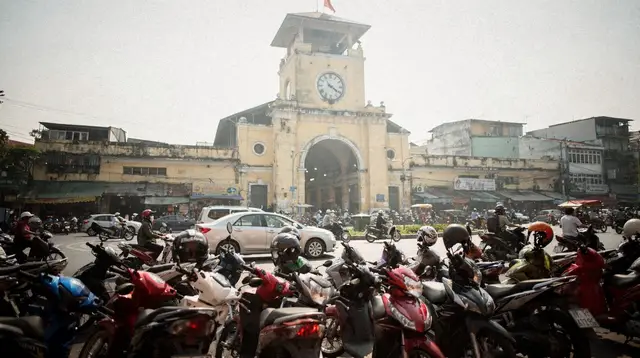
Ben Thanh Market’s clock tower is a smaller, less grandiose piece of the same story — colonial-era market architecture that’s now completely absorbed into the rhythm of a Vietnamese market, tourists and vendors and motorbikes flowing around a French-built frame like it was never a foreign object at all.
District 3 and the quieter villas
If District 1 is the postcard version, District 3 is where I’d send anyone who actually cares about this period rather than just wanting the photo. The streets around here are lined with old French villas, many converted into specialty coffee shops or small offices, their gardens shrunk but their proportions — high ceilings, deep verandas built for heat, shuttered windows — still legible. I spent an afternoon just wandering there with no destination, and it felt more revealing than any single monument in the center.
Cholon and the limits of “colonial”
It’s worth being precise about what this heritage is and isn’t. Cholon, the historic Chinatown spread across District 5 and District 6, has its own remarkable architecture — but it’s Chinese-Vietnamese commercial and religious architecture, temples and shophouses, not colonial French building. I’d keep the two separate in my head, because conflating them flattens both stories.
The confusion worth clearing up
Here’s the mistake I made before I ever set foot in the city: assuming that because so much of the built environment still looks and feels like “Saigon,” the name itself must still be official. It isn’t. Ho Chi Minh City has been the administrative name since 1976. Saigon persists — on shopfronts, in conversation, in the name locals still use for the center — but it’s a name of habit and affection, not of government paperwork. The colonial architecture is a genuinely continuous thread through the city’s history; the name Saigon is a separate, informal one that happens to run alongside it. Don’t let the buildings convince you the map has stayed still.
Seeing it with context, not just a camera
I found the colonial buildings meant more once I had someone explain what I was looking at rather than just walking past with a phone up. A guided walk through District 1 or a slower morning built around cafes in old villas does more for you than a checklist of facades. If you want to combine the two, I’d genuinely recommend the Ho Chi Minh coffee tasting walk through the colonial quarter, which pairs the buildings with the city’s other obsession — coffee — in a way that felt less like sightseeing and more like actually living in the neighborhood for a morning.
For a different angle entirely, an evening on the water gives you the skyline in reverse: the colonial low-rise center giving way to the glass towers behind it. A Saigon River dinner cruise with a buffet or a quieter evening cruise on the Saigon River both let you watch the old city light up from a distance, which somehow makes its scale easier to grasp than standing right in front of any single building.
Where this fits in a longer visit
Colonial architecture is a half-day interest at most, not a whole trip, and I’d pair it with the city’s other big draws rather than build an itinerary around it alone. The War Remnants Museum sits close enough to walk to and gives you the twentieth-century counterpoint to everything nineteenth-century you’ve just seen.
If you’re deciding where to base yourself, staying in the middle of this district makes the whole walk trivial — see the neighborhood guide for the practical side of that decision. And if architecture turns out to be your thing generally, a proper walking tour of Ho Chi Minh City or the more structured classic city tour will get you into buildings and courtyards you’d otherwise walk straight past.
None of this needs a full day of your trip. An unhurried morning in District 1, a slower one in District 3, and you’ll have seen more of colonial Saigon than most visitors manage in a week of rushing between the obvious landmarks.
Temples and Heritage in Ho Chi Minh City
Verified deep-linked GetYourGuide tours. Book through these links and we earn a small commission at no cost to you.
GetYourGuide does not provide a product photo for this activity — the image shows the meeting point, photographed by us.