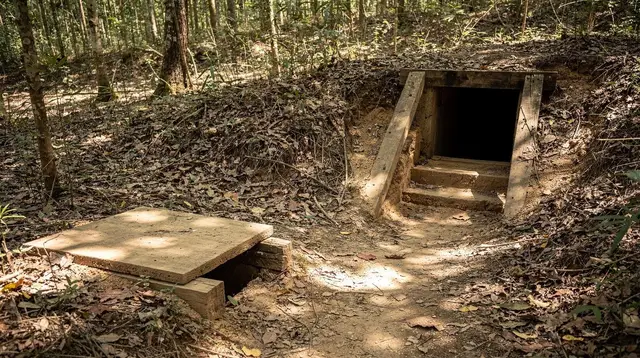
Cu Chi Tunnels Veteran and Military History Guides
What does a veteran or military-history guide add at Cu Chi Tunnels?
A veteran or military-history specialist reads the tunnel system as a former soldier or trained historian would, connecting individual tunnels, traps and bunkers to the wider campaign and to first-hand or documented accounts. A standard tour guide usually recites the same fixed script at each stop, with far less depth and almost no room for follow-up questions.
The guide matters more than the itinerary at Cu Chi
Most visitors booking a trip out to the Cu Chi Tunnels compare tour operators on transport, group size and which entrance they visit — questions well covered by the comparison between Ben Duoc and Ben Dinh and by the separate choice of half-day versus full-day formats. What gets far less attention, and matters at least as much, is who is actually doing the talking once the group is standing at a trapdoor or crouched at a tunnel entrance.
There is a persistent assumption among first-time visitors that a guide is a guide: that whoever leads the group through Cu Chi will deliver roughly the same set of facts, in roughly the same order, regardless of which company sold the ticket. That assumption is wrong, and it costs travellers who care about the history a meaningfully different experience. The gap between a generalist tour leader and a genuine military-history specialist or veteran is one of the largest quality differences in the entire Cu Chi visitor experience, and it has nothing to do with price tier, group size or which of the two sites is visited.
This page is about that gap: what a veteran or specialist guide actually adds, how that differs from the standard commentary, and what to look for when trying to tell the two apart before booking. It does not repeat how the tunnel network itself functioned — that is covered in the dedicated explainer — and it does not revisit the half-day/full-day decision, which is a separate axis entirely.
What a standard guide delivers
The default experience at Cu Chi, on almost any group tour booked through a generic listing, follows a fixed script. The guide narrates the same handful of set-piece facts at each stop: an approximate description of tunnel depth, a demonstration of a camouflaged trapdoor, a walk-through of one or two traps, and an invitation to crawl a short widened tunnel section built for visitors. It is delivered competently, in serviceable English, and it is not wrong. But it is also largely interchangeable from one group to the next, because it is designed to work for a bus-load of visitors with no particular background in the subject and limited time at each stop.
That format has a real function — it orients visitors quickly and keeps a large group moving — but it rarely goes beyond the surface. Questions about tactics, about how a tunnel complex like this related to the wider campaign across the south, or about what daily life underground actually involved tend to get a short, generic answer rather than a considered one. The guide is not being evasive; standard training for this role does not go much deeper than the script, and there usually is not time built into the schedule for genuine back-and-forth.
What a veteran or specialist guide adds
A guide with a military-history background, or a veteran themselves, changes the register of the visit rather than the route. The physical stops are largely the same — the same trapdoors, the same demonstration tunnel, the same reconstructed bunker areas — but the commentary around them is built differently.
A few concrete differences show up consistently on tours led this way:
-
Context beyond the site. The tunnel network at Cu Chi is placed within the broader campaign in the south rather than treated as an isolated curiosity, including its relationship to the wider Ho Chi Minh Trail and the south.
-
First-hand or documented testimony. A veteran guide, whether Vietnamese or foreign, can draw on personal experience or specific documented accounts rather than generic summary; a civilian military-history specialist typically draws on published sources and can cite them.
- Tactical explanation, not just description. Why particular trap designs were used, how tunnel systems were defended and located, and what made the terrain around Cu Chi suited to this kind of warfare, rather than simply pointing out that a trap or tunnel exists.
-
Room for follow-up questions. Specialist-led tours tend to build in more time for discussion, because the guide expects and welcomes questions that go past the basic script.
-
A stated point of view. A Vietnamese veteran, an American veteran, and a civilian historian will each frame the same physical site differently. None of these perspectives is more “correct” than the others, but each is more substantive than a neutral, memorised script trying to avoid any perspective at all.
None of this changes what is physically shown during the visit. It changes what visitors understand about what they are looking at.
Not every “history tour” delivers this
The label on a tour listing is not a reliable guide to what actually happens on the day. Plenty of standard group tours use words like “history” or “in-depth” in their marketing without changing the underlying script or the guide’s background. The genuine difference tends to show up in more specific signals: a listing that names the guide’s own service history or specific area of study, that explicitly promises discussion time rather than just transport and tunnel access, or that is pitched at a smaller group where sustained conversation with the guide is actually possible.
Group size matters here in a practical way. A specialist guide leading a large bus tour still has to keep to a schedule and cannot spend ten minutes answering one visitor’s question about tunnel ventilation systems without losing the rest of the group. The real benefit of a veteran or specialist guide tends to be most visible on smaller or private formats, where the pacing allows for genuine exchange — a broader version of the same logic covered in the comparison of group tours and private tours across southern Vietnam generally.
Vietnamese veterans, foreign veterans, and civilian historians
It is worth being explicit that “veteran guide” does not describe one single kind of person. Three distinct profiles turn up under that general description, and each brings something different:
Vietnamese veterans who served during the conflict, where it took place on this ground, offer a perspective rooted in direct experience of the tunnel network and the wider campaign in the south. Their framing is shaped by that lived history and by decades of talking to visitors about it since.
Foreign veterans, most often American, who served during the war and now live in or regularly visit Vietnam, bring the opposing side’s tactical and personal perspective — what it was like to search for, and struggle against, a tunnel system that was largely invisible from above ground.
Civilian military-history specialists, who did not serve but have studied the conflict in depth, bring a more academic, source-based framing: they can situate Cu Chi within the documented record of the wider war rather than a single personal account.
None of these is a substitute for the others, and a traveller with a strong interest in one particular angle — a family connection to the American side, for instance, or an interest in Vietnamese oral history — may want to look specifically for the guide profile that matches it, rather than assuming any “veteran tour” label covers all three.
Where this fits alongside the rest of a Cu Chi visit
A veteran or specialist guide is one input into the visit, not the whole of it. The physical site is the same regardless of who is leading the group, and decisions about which entrance to use, how long to spend, and what else to combine the trip with are handled elsewhere.
Some visitors extend the day toward the Cao Dai Holy See at Tay Ninh for a very different kind of history and culture; others prefer to keep the focus tight on the tunnels and the wider Ho Chi Minh City war sites, including the War Remnants Museum and the former Independence Palace, both of which pair naturally with a specialist-led morning at Cu Chi and are covered in the Saigon war sites walking tour.
For travellers assembling their own day rather than booking a fixed package, it is worth deciding the guide question first and the logistics second: a strong specialist guide on a modest itinerary tends to leave a deeper impression than an elaborate itinerary led by a generic script.
Choosing a tour built around this kind of guiding
A handful of listed tours are structured specifically around a veteran or in-depth historical guiding style rather than the standard tunnel-and-trapdoor script. The Ho Chi Minh Cu Chi Tunnels tour led by a war veteran is built directly around that first-hand perspective. Travellers who want the tunnels folded into a broader day covering river life and the wider delta region can look at the Cu Chi Tunnels itinerary that combines the site with Mekong Delta history, culture and river life, which still keeps a strong historical thread running through the day.
For a smaller-group format led by a Vietnamese guide with local grounding in the area’s history, the Cu Chi Tunnels and Mekong Delta tour led by a local guide is worth comparing against the veteran-led option above. A more general, well-reviewed standard guided tour of Cu Chi Tunnels remains a reasonable baseline for comparison, useful for gauging how much deeper the specialist options actually go.
Setting expectations correctly
A veteran or military-history guide is not a guarantee of comfort. Personal accounts of the war, whether from a Vietnamese or a foreign veteran, can be blunt, and a civilian historian will not soften the material to make it easier to hear. Visitors sensitive to graphic descriptions of combat or its aftermath should expect a specialist tour to go further into that territory than a standard tour would, not less far. That is, in large part, the point: a script written to be inoffensive to a busload of visitors and a considered account from someone who studied or lived through the conflict are simply not aiming at the same thing.
It is also worth setting aside the expectation that a specialist guide will “perform” for the group in a theatrical sense. The value is almost always in the substance of what is said and in the willingness to engage with real questions, not in stagecraft. A quiet, well-informed answer to a specific question usually says more than an elaborate anecdote delivered on cue.
Frequently asked questions about veteran and specialist guides at Cu Chi
Is every guide at Cu Chi Tunnels a war veteran?
No. Most guides working the site are trained tour leaders repeating a standard script, not veterans. Genuine veteran-led or military-history-specialist tours are a distinct, smaller category that has to be sought out or booked specifically.
Do all Cu Chi tours give the same level of historical context?
No. Depth varies enormously between guides. A generalist guide covers the same handful of facts at every stop, while a veteran or military-history specialist can situate what visitors see within the wider conflict and answer detailed follow-up questions.
Is a veteran guide the same person who fought at Cu Chi?
Not necessarily. Some guides are Vietnamese veterans of the war, others are foreign veterans (often American) offering their own perspective, and others are civilian historians who specialise in the conflict without having served. Each brings a different, valid angle rather than a single fixed one.
Will a veteran-guided tour re-explain how the tunnels themselves worked?
It should assume a visitor already has the basics and go further, into tactics, context and personal or documented testimony, rather than repeating the introductory explanation covered elsewhere.
Does a military-history guide replace the choice between a half-day and a full-day visit?
No, those are separate decisions. The guide’s background shapes the quality and depth of the commentary; the half-day or full-day format shapes how much of the site is covered and at what pace.
Can a veteran-led tour be combined with other stops near Cu Chi?
Yes, some itineraries pair a specialist guide with a stop at the Cao Dai Holy See in Tay Ninh or a boat leg on the Saigon River, though the guide’s depth of commentary is usually strongest at Cu Chi itself, where the subject matter is their focus.
How can a traveller tell a genuine specialist guide from a standard one in advance?
Tour descriptions that name the guide’s background, mention a veteran’s own service, or promise in-depth historical discussion are a reasonable signal; a listing that only mentions transport, tunnel crawling and a gift shop stop is usually the standard format.
War History: Cu Chi Tunnels and the War Remnants Museum
Verified deep-linked GetYourGuide tours. Book through these links and we earn a small commission at no cost to you.
GetYourGuide does not provide a product photo for this activity — the image shows the meeting point, photographed by us.