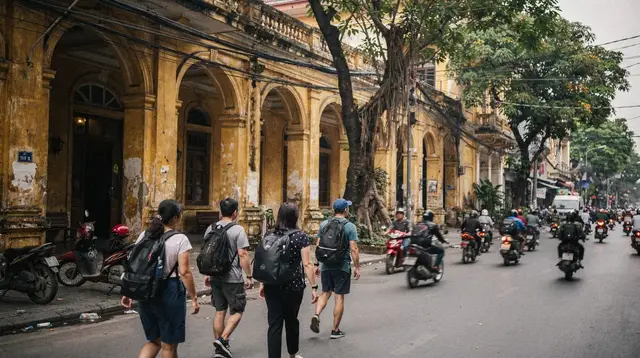
Metro and City Buses in Ho Chi Minh City
Does Ho Chi Minh City have a metro and can visitors use the buses?
Ho Chi Minh City has one operating metro line, Line 1, running from the centre out past Thu Duc, plus an extensive city bus network. Together they cover a growing but still limited share of the city compared with motorbikes, ride-hailing and taxis, which most visitors still rely on for cross-town trips.
A Young Rail Line in an Old Motorbike City
Ho Chi Minh City is still, first and foremost, a motorbike city. Public transport exists, is improving, and is worth understanding before a visit — but it is not yet the backbone of how people move around, and it is easy for a first-time visitor to overestimate what it covers. This guide is about two things only: the metro line and the city bus network, the collective transport options useful for short, cheap trips inside Ho Chi Minh City itself.
It does not cover taxis or ride-hailing apps, which have their own guide at Grab and taxis in Ho Chi Minh City, and it does not cover journeys out to the Mekong Delta or the coast, which run by road and boat and are covered separately at getting to the Mekong Delta and coast by bus, van and boat.
The most useful thing to correct up front: Ho Chi Minh City does not have an extensive metro network comparable to Bangkok or Singapore. It has one operating line. That single fact reframes almost every other question about getting around the city.
Line 1: What It Actually Covers
Line 1, known as Ben Thanh–Suoi Tien, opened in December 2024. It runs from the centre of District 1, near Ben Thanh Market, out along a single corridor through Binh Thanh and into Thu Duc City, the merged area that used to be Districts 2 and 9. It is the first operating urban rail line in southern Vietnam, and for the stretch of the city it serves, it is a genuinely useful, air-conditioned alternative to sitting in road traffic.
What Line 1 does not do is connect the rest of the city to itself. It does not reach the west side of District 1 around the Reunification Palace area on foot-friendly terms, it does not touch Cholon, the historic Chinatown spread across Districts 5 and 6, and it does not cross into District 4 or reach Thao Dien directly except via its own stops along the way. Further lines are planned, and Ho Chi Minh City’s transport authorities have discussed a wider network for years, but nothing beyond Line 1 is open. Treat any claim of a second operating line, or of a network resembling a mature Asian metro system, as premature.
Because this guide avoids stating fares, timetables, service frequency or trip durations that change and date quickly, the practical advice is simpler: if a destination sits directly on the Line 1 corridor, it is worth checking as an option before defaulting to a car. If it does not, the metro is not the tool for that trip.
City Buses: Extensive but Locally Oriented
Ho Chi Minh City’s bus network is large — considerably larger in area covered than the single metro line — and it is used daily by a huge number of residents. Buses connect central districts with outlying areas including parts of Cholon, District 4, and the districts and wards beyond District 1’s tourist core that the metro does not reach.
For visitors, the practical friction is less about coverage and more about usability. Route maps, on-board signage and driver announcements are mostly in Vietnamese, digital route-planning is uneven, and stops are not always obviously marked in areas away from the centre. None of this makes the bus network unusable — many long-term expatriate residents rely on it for routine trips — but it explains why most short-stay visitors, weighing a bus route against a five-minute wait for a ride-hailing car, choose the car. The bus network rewards a bit of preparation (checking a specific route number and its two end points before setting out) more than it rewards showing up at a stop and hoping.
Where Public Transport Fits Against the Alternatives
For a visitor, collective transport is one option among several for moving around the city, alongside motorbike taxis, ride-hailing apps, metered taxis, cyclos in tourist areas, and simply walking short distances within a neighbourhood. The comparison usually comes down to this:
| Option | Best for | Limitation |
|---|---|---|
| Metro (Line 1) | Trips along the Ben Thanh–Suoi Tien corridor, including toward Thu Duc | Single line; does not reach most of the city |
| --- | --- | --- |
| City buses | Cheap trips across a wide area, for those willing to plan a route | Language and signage mostly Vietnamese; less predictable for first-timers |
| --- | --- | --- |
| Ride-hailing apps (cars and motorbike taxis) | Point-to-point trips anywhere in the city | Subject to Ho Chi Minh City’s traffic; see the Grab and taxis guide |
| --- | --- | --- |
| Metered taxis | Similar to ride-hailing, useful late at night or where apps are patchy | Same traffic exposure |
| --- | --- | --- |
| Walking | Short hops within one neighbourhood, such as around Ben Thanh Market or along the Saigon River | Heat, humidity and the need to cross busy streets — see crossing the street in Saigon |
This is a guide to the first two rows of that table. The others have their own dedicated coverage, referenced above and below, because how a visitor should approach a ride-hailing trip or a street crossing is a different question from how the metro line and bus network actually work.
A Practical Day Using the Metro
For a visitor staying in central District 1 with a Line 1 stop within walking distance, the metro can genuinely replace a car for part of a day: a ride out toward Thu Duc City to see Landmark 81 and the Binh Thanh riverside area, for instance, then a ride back into the centre.
It works well as a short, self-contained hop rather than as a spine for a whole day’s sightseeing, because so much of what a first-time visitor wants to see — Ben Thanh Market, Cholon, the War Remnants Museum — sits off the current line. A typical one-day itinerary in the city, such as the one-day Ho Chi Minh City highlights plan, still leans on walking and ride-hailing between stops, with the metro used opportunistically where it lines up.
Buying a ticket at a station is straightforward: tickets are sold at station counters and machines, and stations have staff on hand. The advice in this guide deliberately stops short of naming a fare, because Vietnamese dong prices for public services move and a stale number is worse than no number — check the current fare at the station or the operator’s own signage on the day.
What This Guide Does Not Cover
Three things are outside the scope of a guide to urban metro and bus travel, and are covered elsewhere on this site so this page does not repeat or blur them:
-
Getting to and from Tan Son Nhat Airport. No rail line reaches the airport. That trip runs by public bus, shared minibus, metered taxi or ride-hailing app, and is covered fully in the airport transfer guide and the night arrival transfer guide.
-
Taxis and ride-hailing apps. These are the default for most visitors moving across the city and deserve their own comparison of apps, pricing structures and etiquette, at Grab and taxis in Ho Chi Minh City.
- Trips beyond the city, to the Mekong Delta, Vung Tau, Mui Ne or Con Dao. None of those run by metro or city bus; they run by road coach, private car, boat, or in Con Dao’s case, by air or fast ferry. See getting to the Mekong Delta and coast by bus, van and boat for that separate subject.
A second airport, Long Thanh International, is under construction in Dong Nai province east of the city, but no opening date is reliable enough to state here, and no rail or bus routing to it is settled yet either.
Neighbourhoods and the Metro’s Practical Reach
Because Line 1 anchors near Ben Thanh Market at one end and runs out through Binh Thanh into Thu Duc City, it happens to be genuinely convenient for visitors staying, or considering staying, along that corridor. The guide to where to stay in Saigon by neighbourhood is the right place to weigh that trade-off against staying in the denser, more walkable heart of District 1, where the metro is a nice-to-have rather than a necessity, since almost everything is already in walking or short ride-hailing distance.
Riders heading toward Thao Dien, the leafy expatriate-heavy pocket of Thu Duc City, or toward the riverside stretch near Landmark 81 and the Binh Thanh canals, will find the metro a realistic option for at least part of that trip. Riders headed the other direction, into Cholon or south toward District 4, will not find the metro useful at all and should plan around buses, a taxi, or a ride-hailing car instead.
Combining Public Transport With a Booked Tour
Guided tours and airport-adjacent transfers generally use private vehicles rather than the metro or city buses, simply because a fixed group schedule does not mesh well with public transport’s own timing. A Ho Chi Minh City tour covering the classic centre, or a metro-specific outing such as a short ride paired with skyline views, is one of the few ways a first-time visitor experiences Line 1 with a guide explaining the stops along the way.
a short guided metro ride paired with a look at the city’s skyline is a low-effort way to try the new line without having to plan a route alone, and a broader half-day or full-day city tour naturally uses a private vehicle for everything the metro and buses don’t reach. For a day trip beyond the city, where none of this applies, a day trip to the coastal city of Vung Tau runs entirely by road, independent of any of the transport covered on this page.
Getting the Basics Right
A few points worth restating clearly, because they are the most common source of confusion for first-time visitors reading about transport in Ho Chi Minh City:
-
One metro line, not a network. Line 1 opened in December 2024. It is useful for trips along its own corridor and nothing else.
-
The bus network is large but locally oriented. It works well for anyone willing to check a specific route number in advance; it is not designed around tourist convenience.
-
Neither the metro nor city buses reach the airport, the Mekong Delta, or the coast. Those trips use different transport altogether, covered in their own guides.
- Most visitors still default to ride-hailing apps or metered taxis for point-to-point trips, and to walking for short hops within one neighbourhood — both covered outside this guide.
-
Traffic in Ho Chi Minh City is dominated by motorbikes, more densely than anywhere else in the country, which is part of why the metro’s arrival matters even as a single line; see crossing the street and traffic in Saigon for how to move on foot safely in the meantime.
Ho Chi Minh City’s Metro and Buses — Frequently Asked Questions
Is there a metro in Ho Chi Minh City?
Yes, one line. Line 1, Ben Thanh to Suoi Tien, opened in December 2024 and runs from central Ho Chi Minh City out through Binh Thanh and Thu Duc City. It is the only operating line; additional lines are planned but not yet running.
Can I get around all of Ho Chi Minh City on the metro?
No. Line 1 follows a single corridor and does not reach most of District 1’s west side, Cholon, District 4 or the areas across the Saigon River other than along its own route. For anywhere off that corridor, a bus, a walk, or a ride-hailing car is still needed.
Is Ho Chi Minh City’s metro like the ones in Bangkok or Singapore?
Not yet. Bangkok and Singapore run large, interlinked networks built up over decades. Ho Chi Minh City has a single line. It is a genuine addition to getting around, not a citywide substitute for buses, motorbikes and ride-hailing.
Are city buses in Ho Chi Minh City tourist-friendly?
They are extensive and heavily used by residents, but route information, signage and on-board announcements are mostly in Vietnamese, and English is limited outside central tourist corridors. Visitors who want simplicity generally default to ride-hailing apps instead.
Do the metro and buses reach Tan Son Nhat Airport?
No rail line serves the airport. Airport transfers run by public bus, shared minibus, metered taxi or ride-hailing app; see the dedicated airport transfer guide for that trip specifically.
Can I use the metro or a city bus to reach the Mekong Delta or the coast?
No. Both the metro and the city bus network serve trips inside Ho Chi Minh City only. Journeys to the Mekong Delta, Vung Tau, Mui Ne or Con Dao run by coach, minibus, car, boat or air, covered in a separate guide.
How do I pay to ride the metro or a bus?
Both accept tickets bought at stations or on board, and increasingly a rechargeable card or app-based option. Domestic QR payment apps generally need a Vietnamese bank account, so most visitors buy single tickets in cash or by card at the point of travel.
Getting Around Ho Chi Minh City
Verified deep-linked GetYourGuide tours. Book through these links and we earn a small commission at no cost to you.
GetYourGuide does not provide a product photo for this activity — the image shows the meeting point, photographed by us.