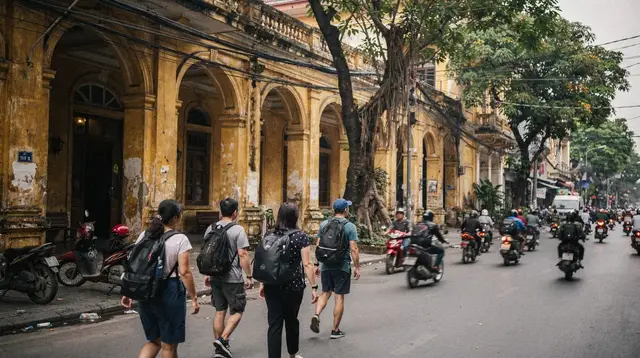
Vietnamese Etiquette and Customs in Southern Vietnam
What are the most important etiquette rules in southern Vietnam?
Use both hands (or your right hand supported by your left) to give or receive anything, dress modestly and remove your hat at pagodas and temples, and keep your voice calm and your face neutral even when you disagree. Direct confrontation and blunt eye contact read as aggressive here, not honest.
I spent my first week in Ho Chi Minh City doing the wrong small things without ever being told, and it took a patient guide on a food tour to point out, gently, why a vendor’s smile had gone a little tight when I’d handed over money with one hand and looked straight into her eyes while she counted change. Nothing about it was a real problem. But it stuck with me, and it changed how I moved through the city for the rest of the trip.
Two hands, always, if you can manage it
The single habit that changes the most is using both hands, or a right hand steadied by the left, whenever you give or receive something. A menu, a fare, a business card, a bag of mangoes, the little stool someone slides over for you at a street stall — all of it. It is not a rule anyone recites, it is just what a hand does here, and a one-handed toss of change back at you, or a one-handed grab from you, reads as careless rather than efficient.
I noticed it most with older people: a market seller in Ben Thanh Market, a grandmother selling che from a cart in Cholon, a monk at the entrance of a pagoda. With anyone visibly older, the two-hand habit stops being optional and becomes the whole tone of the exchange.
The same logic runs through a light bow of the head when you greet someone, rather than a big smile and a loud “hi.” Handshakes happen, especially with anyone in a shop, a hotel or a tour office who deals with foreigners daily, but they tend to be lighter than the grip I was used to, and again often supported with the other hand for someone clearly senior. None of it needs performing. It is closer to a lowered volume than a set of gestures.
Places of worship ask for less, not more
Every pagoda and temple I visited in the south — the Jade Emperor Pagoda, the cluster of temples in Cholon, the Cao Dai Holy See out in Tay Ninh — asked the same quiet thing of visitors: cover your shoulders and your knees, take your hat off, and leave your shoes at the door where everyone else’s are lined up. I kept a light scarf in my bag for exactly this, because the heat means most of what you naturally want to wear during the day is too little for a temple threshold.
What surprised me more than the dress code was the register of behaviour once inside. Voices drop to something close to a murmur, phones go quiet, and people move around the incense smoke and the altars without much hurry. It is not solemn in a heavy way — there is often a side room with people chatting, kids running past — but the core spaces in front of the statues stay hushed.
I found it easiest to watch what the worshippers around me were doing rather than to guess, and to step to the side rather than through the middle of anyone actually praying. The Cao Dai temple in Tay Ninh has its own layered dress and seating conventions for the midday ceremony, and a guide who does that day trip regularly is worth having beside you the first time.
The face stays calm, even when you are not
The part I found hardest to unlearn was my own face. I am used to letting frustration or disagreement show — a raised eyebrow, a flatter voice, a longer pause. In southern Vietnam, that reads as something closer to aggression than honesty, and I watched it land badly more than once before I adjusted.
A misunderstanding over a fare, a wrong order at a stall, a mix-up over a booking: the people around me who handled these best kept a level tone and, often, a small smile through the whole exchange, even while clearly working hard to fix the problem. Losing your temper in public here does not read as passion or directness. It reads as someone who has lost control of themselves, and it tends to make the other person more guarded, not more cooperative.
Direct eye contact sits in the same family of misreadings. Where I come from, holding someone’s gaze signals sincerity. Here, especially with someone older or in a position of authority — a temple caretaker, an older relative at a homestay, a senior staff member — a steadier, softer gaze that breaks away now and then is the more comfortable version, and staring someone down can feel like a challenge rather than attentiveness. I noticed the same pattern on a cooking class I took on the edge of the city, where the household running it clearly appreciated a guest who watched, asked quietly, and let corrections happen without making a scene of getting something wrong.
None of this is really about rules to memorise before you land. It is closer to a lower volume, in gesture and in voice, than I was used to bringing into a conversation, and it rewards patience over insistence almost every time. A street food tour through District 1 or a slower morning in the delta gives you dozens of small, low-stakes chances to practise it before it matters more.
a guided street food walk where a local host models these small courtesies for you as you go, and I found it did more for my confidence than any list of rules could. If you want a slower, more hands-on version, a homestyle cooking class in a local kitchen puts you inside a household for a few hours, which is its own quiet lesson in how guests are expected to behave.
And if your trip includes a day out to the Mekong Delta, where village life and temple visits sit closer together than in the city, a small-group day trip into the delta gives you a guide on hand to translate not just the language but the register of a room.
A few other things settled into place over the trip: tipping is appreciated but not expected the way it is at home, worth reading up on separately in the tipping guide; a handful of basic Vietnamese phrases go further for goodwill than perfect pronunciation ever will; and the coffee culture here comes with its own unhurried social rhythm worth slowing down for.
If you are travelling alone, the solo female travel notes cover a few etiquette points specific to that experience. None of the customs here are fixed festival dates or public holidays — those live on their own page — this is just the everyday texture of getting along with people in Cholon, on a Mekong homestay, or at a market stall in Ho Chi Minh City.
Vietnamese etiquette and customs, answered
What are the most important etiquette rules in southern Vietnam?
Use both hands (or your right hand supported by your left) to give or receive anything, dress modestly and remove your hat at pagodas and temples, and keep your voice calm and your face neutral even when you disagree. Direct confrontation and blunt eye contact read as aggressive here, not honest.
Should I use both hands to give or receive things in Vietnam?
Yes, whenever you can. Money, a business card, a gift, a plate of food, even change from a street vendor — offering and receiving with both hands, or a supported right hand, is read as basic respect, especially with anyone older than you.
Is it rude to make strong eye contact in Vietnam?
Prolonged, direct eye contact, especially with someone older or in a position of authority, can come across as challenging rather than sincere. A softer gaze that looks away occasionally is normal and is not a sign of dishonesty or disinterest.
What should I wear when visiting a pagoda or temple in Ho Chi Minh City?
Cover your shoulders and knees, remove your hat, and take off your shoes wherever you see other visitors’ shoes left at the entrance. Loud, tight or beach clothing stands out uncomfortably in these spaces.
How do people in southern Vietnam handle disagreement or complaints?
Indirectly and quietly, with a kept smile and a level tone, even when someone is genuinely unhappy. Raising your voice or showing visible frustration tends to shut a conversation down rather than resolve it.
Is it okay to touch someone’s head in Vietnam?
No. The head is considered the most respected part of the body, so avoid patting anyone’s head, including a child’s, however friendly the gesture feels to you.
How should I greet people in Ho Chi Minh City?
A nod, a smile and a slight bow of the head cover almost every situation. A handshake is common in business settings, offered with a lighter grip than a Western handshake, and again best done, or received, with both hands for someone senior.
tours.Culture
Verified deep-linked GetYourGuide tours. Book through these links and we earn a small commission at no cost to you.
GetYourGuide does not provide a product photo for this activity — the image shows the meeting point, photographed by us.