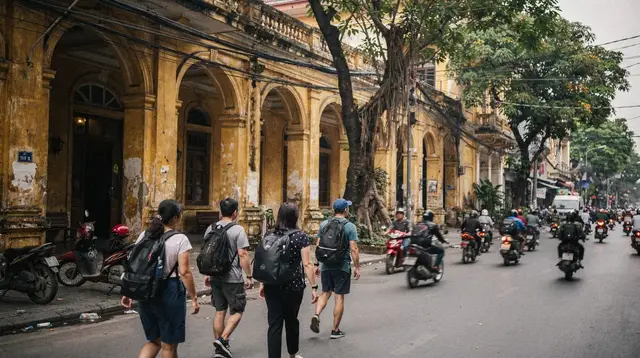
Learning to Cross the Street in Ho Chi Minh City
How do you cross the street in Ho Chi Minh City?
Step off the curb at a steady, unhurried pace and keep walking in a straight, predictable line; the motorbikes read your trajectory and steer around you. Never stop dead in the middle of the road and never suddenly run, since both movements are what riders cannot anticipate. Waiting for a full gap in the traffic on a street like this rarely happens, so the walk itself is the technique.
The first crossing that actually worked
I spent my first morning in District 1 doing exactly what every guidebook tells you not to do: standing on the curb near Ben Thanh Market, watching a river of motorbikes stream past in both directions, waiting for a gap that never showed up. Cars nosed through, a bus leaned on its horn, and the motorbikes just kept coming, three and four abreast, filling every inch of space a car left behind.
After about ten minutes of this I watched an elderly woman with a bag of vegetables walk off the curb without so much as glancing left, and cross the entire street in one unbroken, unhurried line. Nobody swerved hard. Nobody braked to a stop. The traffic simply flowed around her, like water around a rock that had decided to move slowly downstream.
That was the moment the whole city clicked into place for me, and it is the one piece of advice I now give anyone heading to Ho Chi Minh City before almost anything else: don’t wait for a gap, become part of the traffic’s logic instead.
Why waiting for a gap doesn’t work here
Where I’m from, crossing a street means reading a gap in the traffic and moving through it before the next vehicle arrives. In central Ho Chi Minh City, especially around streets like Dong Khoi or the lanes toward Cholon, that gap simply isn’t part of how the street works. The volume of motorbikes is high enough, and their spacing tight enough, that a true opening — several seconds with nothing coming — can be rare on a busy stretch. If you stand and wait for one, you can end up rooted to the curb far longer than you’d like, growing more anxious rather than less.
The riders, meanwhile, are not expecting you to wait for that opening. They’re expecting you to walk. Their whole system of navigating the street, each other, the parked bikes, the vendor carts, the moment a taxi door opens, works on prediction: they see where you are, extrapolate where you’ll be in two seconds, and steer their bike a foot to the left or right accordingly. A pedestrian standing still, or one who suddenly bolts, breaks that prediction. A pedestrian moving at a calm, constant pace is the easiest thing on the street to plan around.
The technique, such as it is
There isn’t much to it, which is part of why it’s hard to believe until you’ve done it:
- Pick your line to the other side and commit to it before you step off the curb.
- Walk at a normal, unhurried pace — not a stroll, not a jog, just a steady human walking speed.
- Don’t stop halfway to reassess, and don’t suddenly speed up because a bike looks close. Both movements are the two things riders can’t anticipate.
- Don’t turn your head to track every bike individually; a general awareness of what’s coming from both directions is enough. Obsessively watching one motorbike often makes people freeze.
- Keep your line straight rather than weaving. A straight line is the easiest thing for a rider forty metres away to plan around.
The first time you do this on a street near Ben Thanh Market or along the edge of Cholon, it will feel like you’re walking directly into moving traffic, because you are. But the motorbikes are not aimed at you; they’re aimed at the gap you’ll have left by the time they arrive, and they adjust continuously as you walk. By the third or fourth crossing of the day, most people stop thinking about it consciously at all.
What this doesn’t cover
This is purely about the mechanics of walking through motorbike traffic — it has nothing to do with the separate, more mundane subject of overcharging or scooter scams around busy tourist streets, which is its own topic and worth reading on its own terms elsewhere on this site. It also isn’t a guide to renting a scooter yourself, which comes with a different set of licence and insurance considerations. This page is only about the very ordinary act of getting from one side of the street to the other on foot.
It’s also worth saying plainly what this page won’t do: it won’t hand you traffic statistics, tell you which hour of the day is worst, or claim to know exactly how many bikes pass a given corner. None of that changes the technique, and treating the street as a data problem tends to make people more anxious, not less. The steady walk works regardless of how busy the street happens to be at that particular moment.
Where it matters most, and where it doesn’t
In practice, the technique matters most in the dense grid of District 1 and through the market lanes of Cholon, where motorbikes vastly outnumber cars and the street itself often has no real gap in the flow. It matters far less on the handful of wide boulevards with heavier car traffic, proper marked crossings and traffic police, where you can simply use the crossing as you would in most cities.
It also isn’t really an issue once you’re outside the densest central streets — in quieter residential lanes, or once you’ve left the city for a Mekong Delta day trip, the same steady-walk instinct still helps but the traffic itself is far lighter and less demanding of it.
If you’re arriving straight from the airport and heading into the centre for the first time, it’s worth reading up on getting around Saigon and on Grab and taxis in Ho Chi Minh City before you land, simply so the first crossing isn’t also your first exposure to how the city moves.
For anyone tempted to rent their own scooter rather than walk or take a ride-hailing car, it’s worth reading about renting a scooter and the licence rules first, since the insurance and legal situation there is stricter than it looks. And if buses or the new metro line interest you as an alternative to walking long stretches, the guide to the metro and city buses covers both.
Learning it by doing, not by watching
I found the fastest way to get comfortable was simply to walk a lot in the first day or two, rather than take a taxi everywhere and postpone the problem. A morning spent wandering District 1 on foot, or one of the evening food walks that move between stalls and side streets, forces the crossing technique to become automatic much faster than reading about it ever could.
If you’d rather do that first walk with someone who already knows the rhythm of the street, a guided evening out is a gentle way in: I’d genuinely recommend the street food tour by motorbike, which puts you in the traffic with a local driver before you’re doing it solo, or the shorter afternoon and street food tour if you’d rather ease in on foot with a guide nearby.
By my second day I’d stopped noticing the crossings as a separate event at all — they’d become just part of walking from the War Remnants Museum to lunch, or from my hotel to the river for an evening walk along the Saigon River. That, more than anything, is the real marker that the technique has taken: the moment you stop bracing for it.
For planning where to base yourself so more of your walking happens on the calmer side of the city, where to stay in Saigon by neighbourhood is worth a look, and for a first full day that puts the technique to immediate use, the one-day Ho Chi Minh City highlights itinerary has you walking through exactly this kind of street from the first morning.
If overcharging and common tourist traps are more on your mind than traffic itself, that’s covered separately in common scams in Ho Chi Minh City, and a broader packing rundown sits in what to pack for Ho Chi Minh City. For a wider sense of what else is walkable nearby, the things to do in Ho Chi Minh City hub is a reasonable next stop.
Crossing streets in Ho Chi Minh City: your questions answered
How do you cross the street in Ho Chi Minh City?
Walk at a steady, predictable pace in a straight line and let the motorbikes adjust their path around you, rather than trying to time a gap.
Is it dangerous to cross the street in Ho Chi Minh City?
It feels alarming the first few times, but the flow of motorbikes is used to pedestrians who move predictably, and riders are actively watching and adjusting, not driving blind.
What is the biggest mistake tourists make when crossing?
Waiting on the curb for a clear gap in the traffic. On a busy central street that gap essentially never comes, so the wait just gets longer and more stressful.
Should I run across the street?
No. Running changes your speed and position in a way riders cannot predict from a distance, which is exactly what makes a crossing dangerous. A steady walk is safer than a sprint.
What if a motorbike is heading straight at me?
Keep your pace and your line. In almost every case the rider has already seen you and is adjusting their own path; stopping or jumping back is what removes the predictability they are relying on.
Does this apply to every street in the city?
It applies to the ordinary streets of the central districts where motorbikes dominate. On a handful of wide boulevards with heavy car traffic and marked crossings, use the crossing and any signal as you would anywhere else.
Is it different at a real intersection with traffic lights?
At a signalled junction, motorbikes still turn across a green light more freely than in many countries, so the same principle holds: keep moving steadily once you start, and don’t stop halfway to reconsider.
Does it get easier?
Yes, quickly. Most visitors are unsettled for the first crossing or two and then find it becomes closer to routine within a day, once they trust the pattern of steady, predictable movement.
tours.Practical
Verified deep-linked GetYourGuide tours. Book through these links and we earn a small commission at no cost to you.
GetYourGuide does not provide a product photo for this activity — the image shows the meeting point, photographed by us.