Tet in Ho Chi Minh City: A Saigonese Lunar New Year
What is Tet like in Ho Chi Minh City?
Tet, the lunar new year, is the most important holiday in Vietnam, and in Ho Chi Minh City it shows up as flower markets full of yellow apricot blossom, family gatherings, and a noticeably quieter, slower city rather than a closed one. The date shifts every year with the lunar calendar, so I never give it a fixed day here.
There is a particular week every year when Ho Chi Minh City stops sounding like itself. The motorbike traffic on Nguyen Hue thins out, the shopfronts along smaller streets in District 1 start pulling down their shutters one by one, and every corner seems to sprout a bucket of yellow flowers. That is how I know Tet is close, long before I check a calendar.
I want to be upfront about one thing: I am never going to tell you the exact date. Tet Nguyen Dan, the lunar new year, follows the lunar calendar, and it lands somewhere between late January and mid-February depending on the year. Some years it feels early, some years it feels late, and printing a fixed date on a page like this one would just be wrong the moment the year changes. If you want the specifics of what a particular month looks like weather-wise, that lives on the pages for January and February. This page is about the feeling of the holiday itself, not the calendar square it sits in.
The flower that actually matters here
If you have read anything about Tet before arriving, you may have pictured pink peach blossom branches leaning against doorways. That is a northern image, tied to hoa dao around Hanoi. Down here, the flower is different, and it matters. Hoa mai, the yellow apricot blossom, is the plant of a southern Tet. In the weeks before the holiday, I see mai trees everywhere: staged outside hotel lobbies, sold in pots the size of a person along the roadside, arranged in tight branches on café counters. A blooming mai tree at the start of the new year is considered a sign of luck and prosperity, and households take the timing of the bloom seriously, trimming and coaxing the buds so they open right around the holiday.
I mention the mix-up because I still see it in guidebooks and old blog posts written from a northern perspective and pasted onto southern pages. If someone tells you to look for pink peach blossom in Ho Chi Minh City for Tet, they are describing Hanoi, not here. In the south, yellow is the color of the season.
Where I go to feel it: the flower markets
The flower market along Ho Chi Minh City’s Nguyen Hue walking street is the one most visitors stumble into, usually by accident, in the days leading up to Tet. Stalls take over the whole boulevard: mai branches, kumquat trees heavy with small orange fruit, marigolds, chrysanthemums, and increasingly elaborate flower displays built for photographs as much as for buying. It gets crowded, in a cheerful, unhurried way, with families walking slowly and stopping every few meters to admire someone else’s kumquat tree.
Smaller neighborhood markets do the same thing on a quieter scale. In District 1 side streets and around Ben Thanh Market, vendors set up temporary flower stalls that appear almost overnight and vanish just as fast once the holiday passes.
Over in Cholon, the city’s historic Chinese quarter, the mood leans further into the season too, with red and gold decorations layered over the neighborhood’s usual mix of temples and shophouses; the Cholon neighborhood guide is a good starting point if you want to wander there before or after the holiday rush. I like walking Ben Thanh’s surrounding streets during this window for exactly this reason, and if markets are your thing generally, the markets and shopping guide covers what is normally on offer there outside the Tet season too.
A family holiday, not a shutdown
Here is where I think a lot of visitors get the wrong idea. Tet is often described as “the city shutting down,” and that is not quite accurate. It is more that the rhythm changes. Many Saigonese travel to their hometowns, often outside the city, to be with extended family, which does thin out the population in some residential pockets. Family-run restaurants, the small pho and com tam stalls that depend on one household running them, will often close for several days so the owners can be with their own relatives. That is a real gap worth planning around if you had your heart set on a specific street-food spot.
But it is not a closed city. Hotels stay open. Many larger restaurants, convenience stores, and the main attractions keep running, sometimes on adjusted hours. What changes most is the atmosphere: less traffic noise, more families out walking together in new clothes, red envelopes changing hands, incense burning at pagodas and household altars. It is, honestly, one of my favorite times to just sit at a street corner and watch the city be itself rather than perform for visitors.
Practical notes without the fake precision
I am deliberately not giving you closing hours, ticket prices, or visitor numbers for this period, because they shift year to year and a specific figure printed here would age badly fast. What I will say from experience: book accommodation and any transfers early if your trip overlaps with the holiday window, because domestic travel gets heavy and prices for both lodging and transport tend to rise.
If a specific tour or cruise matters to your plans, confirm it is running as normal rather than assuming a typical schedule, since some operators scale back for a few days around the holiday itself. For a fuller rundown of what tends to close and what stays open, the Tet closures guide goes into more detail than I want to repeat here.
If you are choosing where to base yourself for a Tet visit, staying central makes the flower markets and pagoda visits easy on foot; the neighborhood guide to staying in Saigon is where I’d start.
A few ways to lean into the season
I do not think you need an organized activity to feel Tet in Ho Chi Minh City; walking Nguyen Hue in the days before the holiday does most of the work. But if you want a guided way in, a Saigonese lunar new year market tour walks you through the flower markets and local Tet customs with someone who can explain what you are looking at.
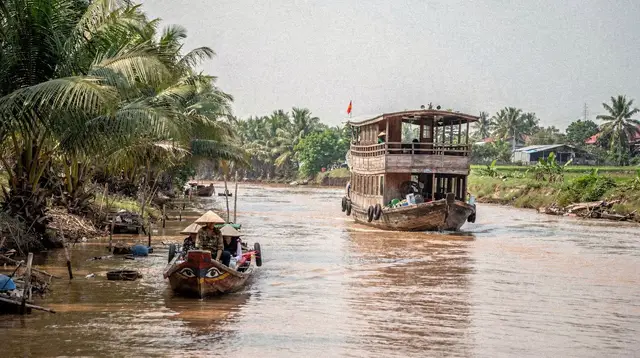
If you would rather see the city’s holiday lights from the water, a Saigon River dinner cruise gives a different, calmer angle on the same festive city. And if your trip stretches beyond Tet week itself, a small-group Mekong Delta day trip is a good way to see how the same season plays out among the delta’s orchards and canals, where kumquat and mai trees are often grown for the whole city’s markets.
Why I keep coming back to this week
I have spent enough Tets in this city now to notice the small rituals more than the big ones: someone re-stringing lights on a mai tree outside a shophouse in the run-up to a national holiday, a grandmother handing out red envelopes on a plastic stool outside a shuttered shop, the specific hush of a normally loud street on the morning of the new year itself. None of that shows up in opening hours or ticket prices.
It is the reason I would rather describe Tet to you in terms of flowers and family and a slower pulse than in dates and numbers that will be wrong by next year anyway. If you want to understand more of what shapes daily life and manners here the rest of the year, Vietnamese etiquette and customs and how southern cooking differs from the north are both good companion reads to this one.
Frequently Asked Questions About Tet in Ho Chi Minh City
When does Tet fall in Ho Chi Minh City?
Tet follows the lunar calendar, so the date moves every year, usually landing somewhere between late January and mid-February. I do not print a fixed date on this page because it would be wrong the following year.
Is Ho Chi Minh City closed during Tet?
No. Some family-run shops and small restaurants close for a few days to be with relatives, but hotels, many restaurants, convenience stores, and the main sights generally keep running. The city feels quieter, not shut.
What is hoa mai and how is it different from hoa dao?
Hoa mai is the yellow apricot blossom that fills flower markets and living rooms across the south for Tet. Hoa dao, the pink peach blossom, is the northern equivalent used around Hanoi. Mixing the two up is a common and easily corrected error.
Where do the flower markets happen?
The best-known flower market runs along Nguyen Hue walking street and spills into nearby District 1 streets in the days before Tet, alongside smaller neighborhood markets across the city.
Is Ho Chi Minh City a good place to spend Tet as a visitor?
Yes, if you enjoy atmosphere over checklist sightseeing. Expect a warmer, more personal mood, some closed shopfronts, and transport that gets booked up early, so I always suggest arranging accommodation and any transfers well in advance.
Should I still book tours around Tet?
Some operators pause or reduce departures for a few days around the holiday itself, so I book ahead and stay flexible rather than assuming a normal schedule.
Seasonal Guide
Verified deep-linked GetYourGuide tours. Book through these links and we earn a small commission at no cost to you.
GetYourGuide does not provide a product photo for this activity — the image shows the meeting point, photographed by us.