Ho Chi Minh City in March: The Last Calm Before the Heat
What is Ho Chi Minh City like in March?
March sits inside the dry season, so the sky stays clear and rain is essentially absent. It's a transition month: the comfortable stretch of the dry season is ending and the heat is climbing toward its April peak, which changes how I schedule the day more than anything else.
What March Actually Feels Like on the Ground
I keep coming back to Ho Chi Minh City at different points in the year, and March is the month I associate with a very specific mood: everything still looks and sounds like the easy dry season, but the air itself has started to change. The sky over District 1 stays a hard, bright blue almost every day, the pavement outside my hotel is dry by the time I step out in the morning, and there isn’t a hint of the rain that will eventually define the wet season later in the year. If you’ve read anything about this city’s climate in general, you already know it runs on two seasons, not four, and March belongs firmly to the dry one.
What March adds to that baseline is a sense of urgency in the heat. It doesn’t arrive all at once. The early mornings around Ben Thanh Market are still manageable, almost pleasant, and I can walk a few blocks without needing to duck into shade. But by the middle of the day, the sun has a weight to it that wasn’t there earlier in the dry season, and I notice myself gravitating toward whichever side of the street has an awning. It’s building toward April, which is the hottest point of the year here, and March is unmistakably the runway into that.
The Confusion I Want to Clear Up
The mix-up I hear most often, usually from people planning a trip a few months out, is the assumption that if the wet season starts sometime around May, then March or April must already be catching the first showers. It’s a reasonable guess, and it’s wrong. The transition here isn’t gradual rain building up over weeks — it’s closer to a switch. The dry season holds its ground with a mostly cloudless sky right through March, and the shift to the pattern of short, heavy afternoon downpours doesn’t really take hold until later. If you’re standing in District 3 or wandering through Cholon in March, an umbrella in your bag is really about the sun, not the clouds.
I think this matters practically, because it changes what you pack and how you plan around weather at all. In March, weather isn’t the variable — heat management is. I’m not adjusting my day around when the rain might hit; I’m adjusting it around when the sun gets hardest to be under.
How I Actually Structure a March Day
Given all that, my March routine in the city has shifted toward front-loading the walking. If I want to properly explore Ho Chi Minh City on foot — the backstreets, the markets, the older colonial corners — I try to get most of it done before the middle of the day. That’s when I’ll head toward the river for a slower stretch, since a walk along the Saigon River with some breeze off the water is a noticeably easier way to spend late morning than the same walk two hours later.
Midday, I’ve learned to stop fighting it and just build in a real break — a long lunch somewhere with air conditioning, a coffee shop with a slow ceiling fan, whatever gets me out of direct exposure for a couple of hours. Then the afternoon and evening reopen for anything active again, and this is when I like locking in a full-day excursion that gets me out of the city entirely, since the countryside doesn’t hold heat the way the dense blocks of the centre do.
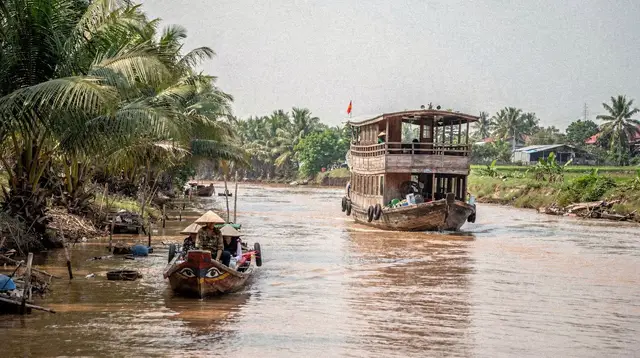
This is actually the logic behind timing something like the Cu Chi Tunnels day trip for March rather than pushing it into peak-heat April — an early departure gets you underground and in the shade of the tunnel network before the hottest part of the day sets in. The same thinking applies to a day out toward the Mekong Delta: I’d rather book something like the small-group Mekong Delta day trip in March, when the dry season is still holding, than gamble on it once the wet-season pattern properly sets in later in the year.
Evenings Are Where March Rewards You
If there’s a part of the day that genuinely improves in March, it’s the evening. Once the sun drops, the heat that built up during the day eases off just enough to make being outside comfortable again, and the city’s rooftop scene and river cruises feel like they were built for exactly this stretch of the calendar. I’ve taken the Saigon River dinner cruise in March specifically because the dry, clear sky gives you an actual view of the skyline instead of a hazy or rain-threatened one, which isn’t guaranteed once the weather pattern turns later in the year.
I’ll also use March evenings to wander Dong Khoi and the Nguyen Hue walking street without the discomfort that creeps in by midsummer. It’s one of the reasons I think March, despite the rising daytime heat, still counts as one of the more forgiving months to be based in the centre — the discomfort is confined mostly to a window in the middle of the day, not spread across the whole 24 hours.
Who March Actually Suits
I’d point March toward travellers who want the reliability of the dry season — no rain interruptions, no rearranged plans — but who are also fine trading some of the milder comfort of December or January for a schedule that leans on early starts and midday breaks. If you’re someone who naturally wakes early and doesn’t mind resting through the hottest hours, March works well. If you’re planning to be outdoors non-stop from breakfast to sunset with no downtime built in, I’d think harder about it, simply because the heat by late March genuinely asks for that kind of pacing.
For day trips specifically, I’d rather go in March than wait — a classic Mekong Delta day tour departing early morning still gets you comfortable hours on the water and in the orchards before the day’s heat peaks, which is a trade-off that only gets tighter as the calendar moves into April.
For broader planning beyond this single month, I’d read up on how many days to give southern Vietnam and on visiting during the dry season more generally, since March is really a specific chapter inside that larger pattern rather than a rule of its own. It’s also worth thinking about where to stay by neighborhood, since a base close to shaded streets or riverside breeze makes the midday stretch easier to manage.
March in Ho Chi Minh City: Common Questions
Does it rain in Ho Chi Minh City in March?
No, not meaningfully. March sits inside the dry season, and the sky stays largely clear. The shift toward the wet season’s short, heavy afternoon downpours comes later, not in March.
Is March hotter than earlier dry-season months?
Yes. March is a clear step up in heat compared to the earlier stretch of the dry season, and it keeps climbing toward the hottest point of the year in April. I treat it as the month where I start actively managing the middle of the day rather than ignoring it.
Should I avoid outdoor day trips in March?
Not at all — I just schedule them for early departures. A morning start on something like the Cu Chi Tunnels or a Mekong Delta excursion gets you through the most exposed parts of the itinerary before the heat is at its worst.
Is March a good time to explore the city on foot?
It’s good in the early morning and evening. I keep my walking around Ben Thanh Market and the central districts to those windows and treat midday as a break rather than more walking time.
Do I need to worry about my March trip clashing with Tet?
Possibly, since Tet falls on a different date each year between late January and mid-February and isn’t fixed to March. It’s worth checking the specific year’s date before you travel, but March itself is usually well clear of the holiday closures.
Is March better than April for a first visit?
I’d lean toward March if given the choice between the two, purely because the heat, while rising, hasn’t yet reached its peak. April pushes the same conditions further, with less relief even in the early morning.
What should I pack differently for March compared to December?
Nothing dramatic changes in terms of rain gear, since neither month sees real rainfall. What I add for March is more sun protection and a stronger habit of carrying water, since the daytime heat is noticeably more demanding than earlier in the dry season.
Can I still do a full day out of the city in March?
Yes, and I’d recommend it while the dry season is still intact. Day trips toward the Mekong Delta or inland toward Cu Chi remain very workable in March; I’d just build the schedule around an early start rather than a leisurely late-morning departure.
Seasonal Guide
Verified deep-linked GetYourGuide tours. Book through these links and we earn a small commission at no cost to you.
GetYourGuide does not provide a product photo for this activity — the image shows the meeting point, photographed by us.